A Day in the Life of a Well-Organized Retail Business
What separates a stressful business day from a smooth one? It's not luck, it's systems.
Imagine walking into your shop at 8:00 AM and knowing before you even greet your first customer exactly what stock you have, what sold best yesterday, and what needs to be reordered. No guesswork. No spreadsheet panic. No scribbled notes.
That's what a well-organized retail business looks like. And in this post, we're going to walk through a full business day — hour by hour — to show you what efficient retail operations actually feel like in practice, and the tools that make it possible.
8:00 AM — Opening Up: Know Before You Sell
A well-run retail day doesn't start at the counter. It starts with a quick check-in on the health of the business.
Before the first customer walks in, a smart retailer pulls up their dashboard. At a glance, they can see:
- Yesterday's total sales and revenue
- Low-stock alerts on fast-moving products
- Pending orders or customer follow-ups
This isn't a luxury, it's a habit. When you have a centralized business management system, your morning briefing takes two minutes, not two hours. You know what products to push today, what to hold back on, and where your team needs to focus.
9:00 AM — Doors Open: The POS Experience
The first customer walks in. They know what they want. Your job is to serve them fast, accurately, and professionally.
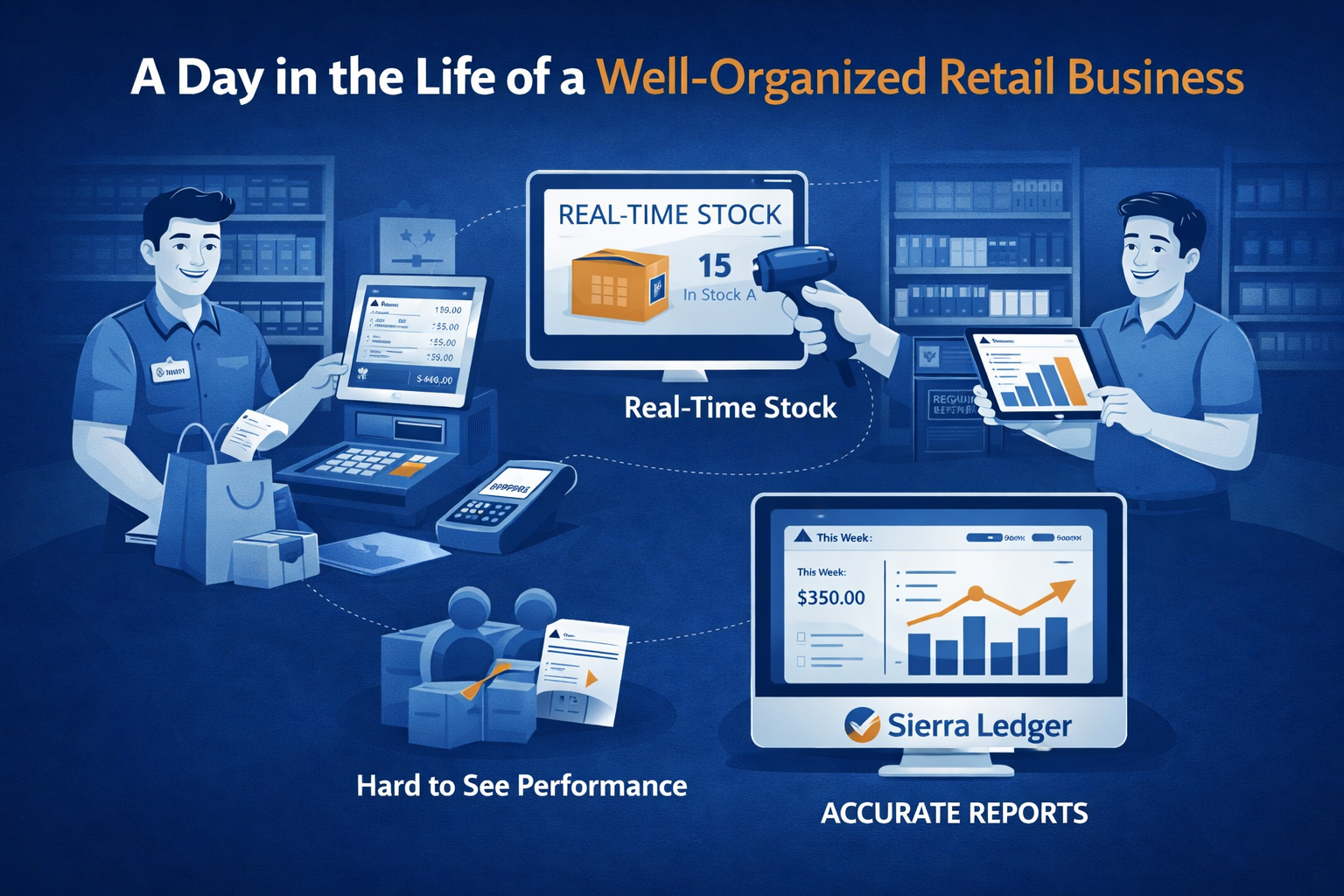
A modern Point of Sale (POS) system makes this effortless:
- Search for a product by name or scan a barcode
- The price populates automatically
- Apply a discount if they're a loyal customer
- Accept payment
- Print or send a digital receipt in seconds
No calculator math. No manual price lookups. No "hold on, let me check the back."
A smooth POS experience isn't just good for the customer, it's good for your data. Every sale is recorded instantly, feeding into your inventory count and daily sales report without any extra effort from you.
11:00 AM — The Mid-Morning Rush: Inventory Doing Its Job
By mid-morning, you've processed a dozen transactions. Behind the scenes, something important is happening that most business owners take for granted or miss entirely when it goes wrong.
Your inventory is updating itself.
Every time a product is sold, your stock count goes down. Every time you receive new goods and log them in, the count goes up. This live tracking means:
- You never accidentally sell something you don't have
- You get alerts before stock hits critical levels
- You can see which products are moving fast and which are collecting dust
Without this, businesses end up in one of two painful situations: overstocking (money tied up in unsold goods) or stockouts (losing sales because shelves are empty). Neither is acceptable when good inventory management is available.
1:00 PM — Lunch Break: Customer Records That Build Loyalty
While things slow down over lunch, it's a great time to think about the people who keep your business alive your customers.
Do you know who your top buyers are? Do you have their contact details? Do you know what they usually buy, how often they visit, and what their purchase history looks like?
A customer records system turns one-time buyers into repeat customers. With proper records, you can:
- Reach out to customers with relevant promotions
- Offer personalized service ("Last time you bought X, you might like Y")
- Track credit or outstanding balances
- Resolve disputes with a clear transaction history
Building relationships isn't just a soft skill, it's a business strategy. And it's only possible when you have the data to back it up.
3:00 PM — Afternoon Stock Check: Products and Pricing Under Control
Midafternoon is often when business owners catch up on the product side of operations, reviewing what's listed, updating prices, adding new items, or retiring old ones.
A solid product management system means:
- Every item has a clear name, code, price, and category
- Pricing updates reflect instantly at the POS
- You can bundle products or set up variants (sizes, colors, etc.)
- Suppliers and purchase costs are tracked alongside selling prices
When your product catalog is clean and current, your entire operation flows better. Your staff can find items quickly. Your reports are accurate. Your pricing is consistent.
5:00 PM — End of Day: Reporting That Tells the Truth
This is the moment most business owners either dread or look forward to, depending on their systems.
Closing time means running your daily sales report. A good report answers:
- How much did we make today?
- What were the best-selling products?
- How many transactions were processed?
- What payment methods were used?
- How does today compare to last week or last month?
When your data is properly tracked throughout the day, generating this report is automatic. It's not a manual tally; it's a clean summary that gives you real insight into how your business performed.
And insight leads to decisions. Maybe you notice one product is underperforming. Maybe Thursday afternoons are consistently slow. Maybe a particular staff member's shift always coincides with higher sales. The numbers tell stories if you're listening.
6:00 PM — Closing Up: The Peace of Mind That Comes With Order
The last customer leaves. The door is locked. And instead of sitting down to manually reconcile receipts and scribbled notes, your team can close up confidently.
Because everything was tracked. Because the numbers match. Because tomorrow morning, the cycle begins again smoothly, predictably, and professionally.
That's what business management done right feels like.
The Bottom Line: Systems Create Freedom
A well-organized retail business isn't run by superhuman owners with perfect memories. It's run by people who've built the right systems, systems that handle the details so the owner can focus on growth, relationships, and the bigger picture.
Whether you're running a single business or managing multiple locations, the fundamentals are the same:
- A fast, reliable POS
- Real-time inventory tracking
- Clean customer records
- Organized product management
- Reports that give you real insight
Sierra Ledger was built to bring all of this together in one place, designed for real businesses, built for everyday use, and priced for businesses that are serious about growth without the complexity.
Ready to see what your business day could look like? Try Sierra Ledger today →